



Current Research
California Ecosystem Futures
California is the most diverse state in the US, harboring incredible variety in climates, species, landscapes and ecoregions. California is also a leader in climate and biodiversity policy. Our work in California is inspired by the opportunity to contribute science-based insights to policy, leveraging data synthesis, experiments and vegetation modeling. A key effort is adapting and applying the FATES dynamic vegetation model to provide ecologically robust projections of ecosystem and biogeographic change statewide. Our work so far spans mixed conifer forests in the Sierra Nevada Mountains, annual grasslands, oak woodlands, and associated wildfire, management fire, and treatments designed to enhance forest resilience. We are particularly interested in improving simulation of regeneration processes.
- Western Fire and Forest Resilience Collaborative
- Wildfire drivers and impacts on air pollution and vegetation in a changing climate: an integrated remote sensing and modeling approach
- Simulating the heterogeneous consequences of widespread forest health treatments for California mixed conifer forest resilience to climate change and wildfire
- California Ecosystem Futures: The Future of California Drought, Fire, and Forest Dieback
Hydroclimate Change and Rocky Mountain Forest Dynamics
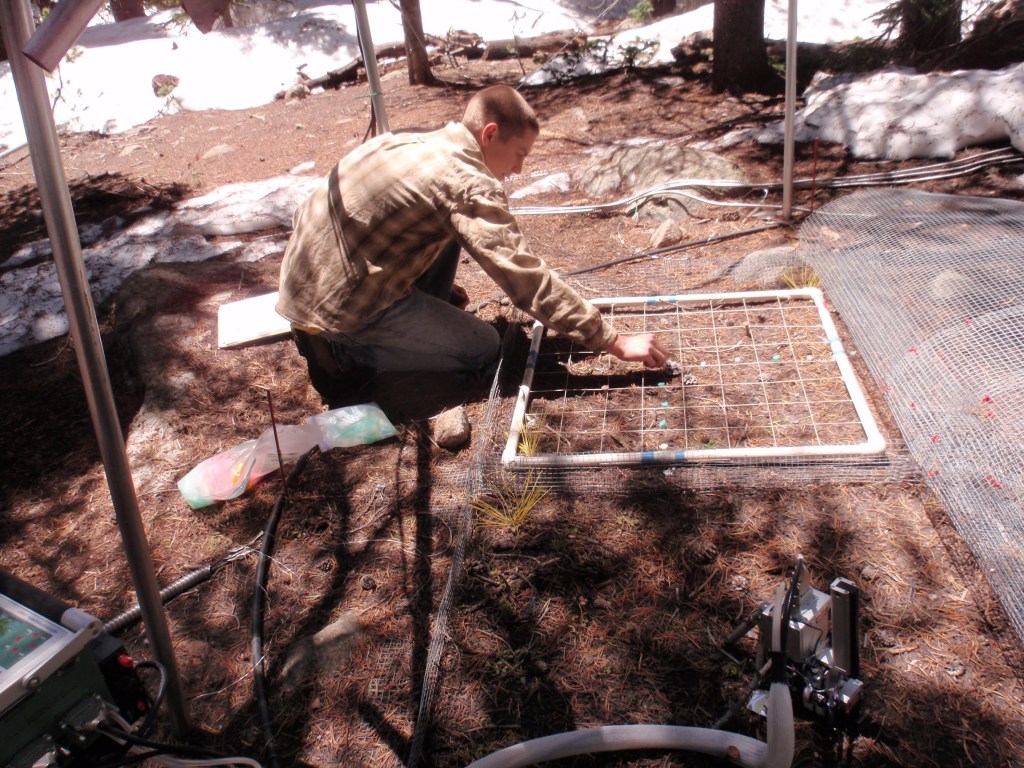
Forest ecosystems are a critical lever on the hydrological cycle in Western U.S. mountain ranges, influencing snowmelt and water flow. Rising temperatures and changes to snow accumulation and melt are altering forest structure and distribution, including through disturbances such as insect outbreaks and wildfire. We have been using field experiments and observations, as well as model simulations, to understand and project changes in the distribution of tree species and structure of forests in the Colorado Rocky Mountains. A key effort examines the role of topographic heterogeneity in amplifying or buffering forest change.
- East River Watershed Forest Ecohydrology
- Western Fire and Forest Resilience Collaborative
- Alpine Treeline Warming Experiment
Alpine Plant Community Change
Alpine plant communities are well adapted to often harsh growing conditions above treeline but are now subject to warmer temperatures and changes in snowpack. We’re using long-term observations near the Rocky Mountain Biological Laboratory, as part of the Global Observation Research Initiative in Alpine environments (GLORIA), to examine how alpine plant communities are changing. As part of the ATWE, an active warming experiment, we also studied alpine plant responses to warming and water addition, and associated changes in snowpack and water availability.
Tropical Forest Disturbance and Recovery Dynamics
Tropical forests are the largest land sink for CO2 in the biosphere and under ongoing pressure from land use change and degradation, which contributes to carbon emissions. While tropical rainforests may be vulnerable to climate change-driven drought, they also are the most diverse forests in the world, which may help buffer negative effects of climate change. Our tropical forest research has focused on forest functional composition and disturbance and recovery dynamics, primarily using demographic vegetation models and data synthesis. A key interest has been simulation of regeneration processes.
Past Research
Endophytic Nitrogen Fixation in Conifers
New technology and techniques are enabling a deeper understanding of how diverse microbiota mediate biogeochemical cycles. Both theory and observations in boreal and temperate forests predict unknown sources of nitrogen (N) to these systems. In collaboration with Carolin Frank’s group at UC Merced, we were the first to quantify N fixation by bacterial endophytes in healthy conifer foliage in subalpine forests. We have contributed to work by Carolin Frank’s group to determine the genetic and functional diversity of these bacterial endophytes across mountain ranges of the Western United States.
Effects of Agriculture on Climate
Characteristics of the land surface, particularly land use and crop management, affect weather and climate with local effects on par with those from increased greenhouse gases. In our prior work, we used regional climate and land surface models, as well as observations, to quantify the influences of natural and managed ecosystems on the climate. We studied how irrigation and crop development affect local and regional temperatures, precipitation, wind, and humidity.
 Kueppers Lab Group